
China Industrial Cooperation Association
Shanghai Federation of Industrial Economics
Shanghai Federation of Economic Organization
Green Industry Enerey Conservation Branch,CICA
Industrial and Information Technology Equipment Engineering Research Institute (Beijing) Co., Ltd
Shanghai Berrick Exhibition Co., Ltd
In 2025, "embodied intelligence" was written into the Government Work Report for the first time: "We will establish a mechanism for increasing investment in future industries, and foster future industries including bio-manufacturing, quantum technology, embodied intelligence and 6G", marking it as one of the future industries prioritized for national cultivation.
What exactly is embodied intelligence? How does it differ from traditional artificial intelligence? How to sort out the logical relationship among embodied intelligence, intelligent robots and humanoid robots? This article provides a detailed breakdown.
Embodied Artificial Intelligence (EAI) is a cutting-edge interdisciplinary field integrating artificial intelligence and robotics. The concept can be traced back to 1950, when Alan Turing, the father of computer science, first put forward the vision of embodied intelligence in his paper Computing Machinery and Intelligence. Its core logic lies in that intelligence must be equipped with a physical entity (a "body"), through which it interacts with, perceives and learns from the surrounding environment in real time, so as to generate intelligent behaviors and environmental adaptability.
Simply put, embodied intelligence refers to intelligent agents that can think, perceive and take action. They step into the physical world, observe via "eyes", operate via "hands" and move via their "bodies" to actively complete various tasks.
A straightforward way to understand embodied intelligence is to compare it with the familiar concept of "disembodied intelligence".
Disembodied intelligence (represented by ChatGPT, ERNIE Bot and other large language models) exists purely as software without any physical form. It analyzes, reasons and generates content by processing massive datasets, yet lacks the capability to interact directly with the physical world. It is analogous to a resourceful strategist who can devise winning plans behind the scenes, but cannot step onto the battlefield to fight in person.
By contrast, embodied intelligence owns a physical body and generates intelligence through dynamic interaction between the body and the environment. Such intelligence is not pre-programmed; instead, it continuously learns and evolves within a real-time closed loop of "perception → decision-making → action → re-perception", much like an infant learning to walk through repeated trial and error.

Embodied vs. Disembodied: Two Forms of Intelligence
Can You Distinguish Embodied Intelligence, Intelligent Robots and Humanoid Robots?
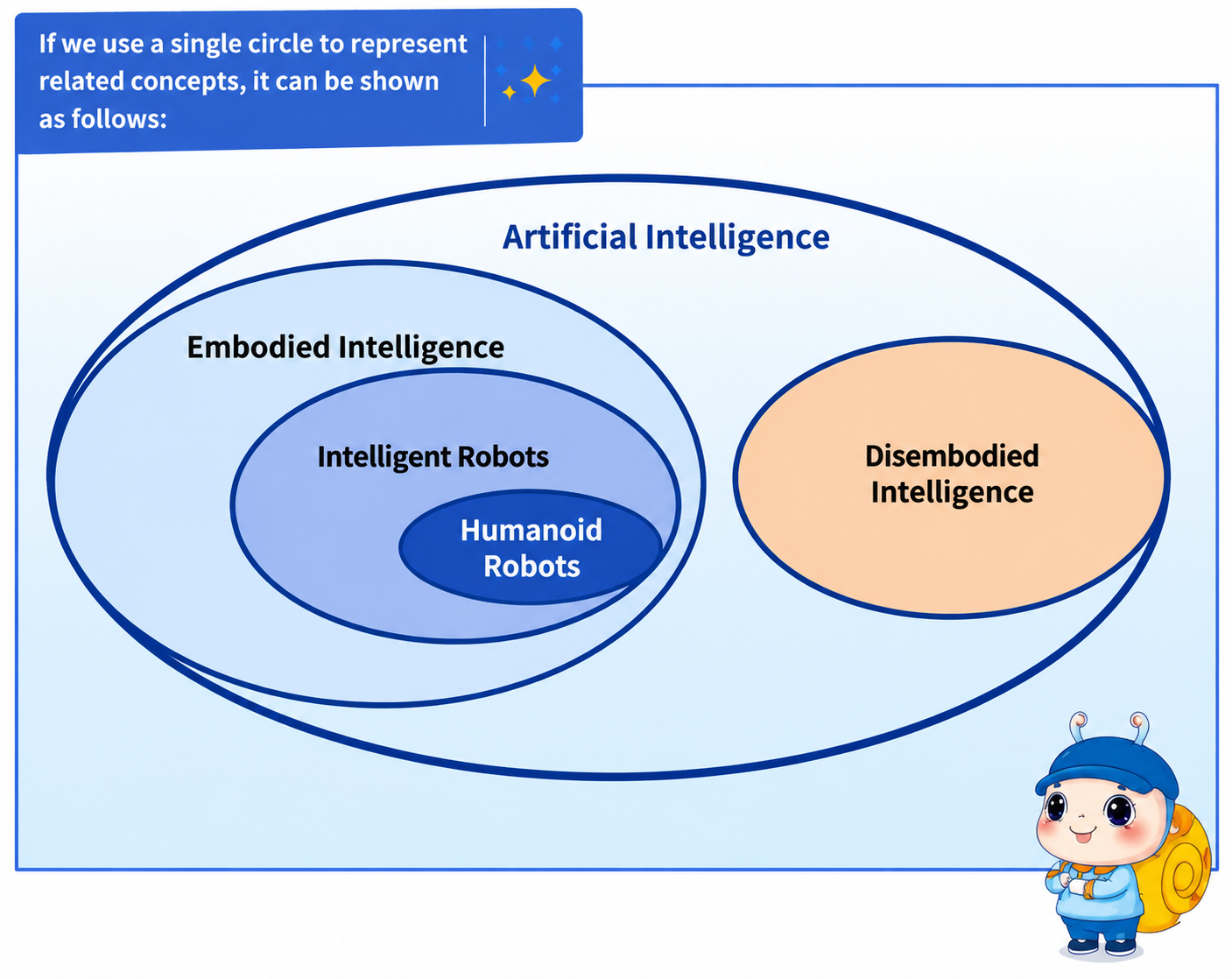
Embodied Intelligence can be regarded as an ideology or a theoretical concept, while intelligent robots serve as one of its primary application carriers and product forms. Industrial robots, service robots and other common robot types we mention all embody embodied intelligence, provided they are equipped with autonomous perception, decision-making and interaction capabilities.
Going one step further, humanoid robots represent an advanced category of intelligent robots. Their human-like form is widely recognized as one of the most promising universal carriers for embodied intelligence, best suited to operate within human living and working environments.
The logical relationship between these concepts can be summarized in the following diagram:
From an investment perspective, embodied intelligence is far more than a buzzword in technology; it stands for a massive future industrial track brimming with investment opportunities. The embodied intelligence industry covers a complete value chain spanning basic hardware, vertical application scenarios and ecological services, encompassing core components (precision motors, reducers, dexterous hands, sensors, etc.), AI algorithms and foundation models, as well as robot body manufacturing.
Meanwhile, the R&D of embodied intelligence technologies features high technical barriers, long product iteration cycles and heavy capital requirements. In addition, its commercialization roadmap remains to be validated over time. Investors shall maintain a clear understanding of these risks, and keep a close eye on the technical viability and sustainable business models of relevant enterprises.